1938–1944
Assisting Jewish refugees
Finnish Jews had direct contact with Nazi Germany's persecution of the Jews when, in late summer 1938, over a hundred Jewish refugees from Austria arrived in the country. Those who did not manage to continue their journey onward remained in Finland for the time being. After the deportation of eight refugees in November 1942, fear of further extraditions weighed on the refugees' minds, until they reached safety in Sweden in the spring of 1944.

Refugees arrive
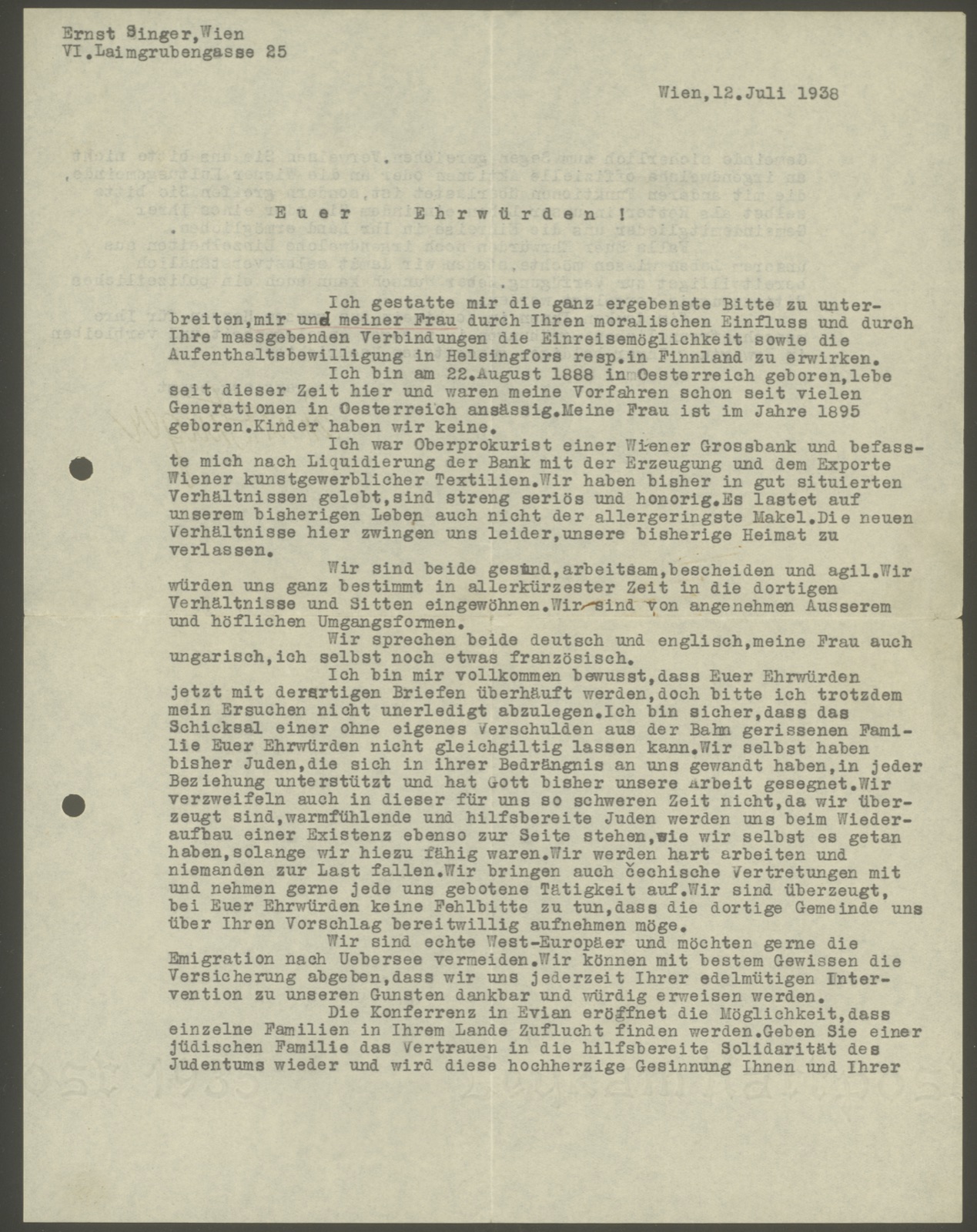
When Nazi Germany annexed Austria on 12 March 1938, the persecution of Jews and the systematic plunder of their property began immediately. Jews desperately tried to leave the country, but only a few managed to obtain a visa or asylum before the borders were effectively closed.
The Finnish consulate in Vienna granted entry visas to some, and refugees initially began arriving individually. On 12 August, the steamship Ariadne brought around 55 refugees to the country at once. At first, there was no wish to let them ashore, but pressure from the Social Democrats made the authorities change their decision. However, the next ship which carried around 60 refugees was turned back on 19 August. The fate of these refugees has not been established to this day.
A refugee committee is established
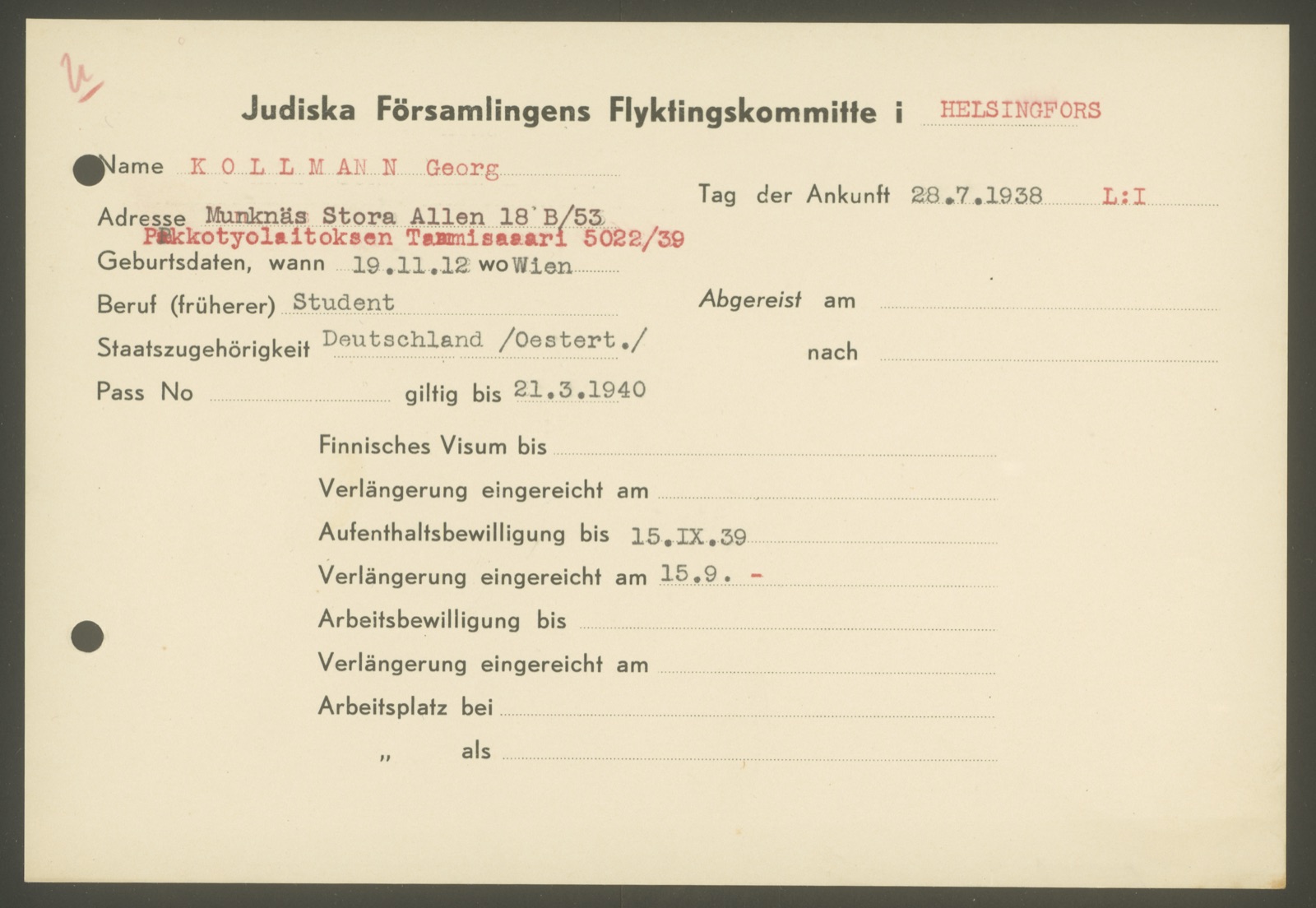
Responsibility for helping the Jewish refugees fell to the Jewish communities, and refugees were placed not only in Helsinki but also in Turku and Viipuri (present-day Vyborg, Russia). Shortly after their arrival, a refugee committee was established in Helsinki, whose first chairman was Bernhard Blaugrund. The committee's task was to see to the refugees' financial support; funds were obtained from foreign aid organisations, such as the American Joint Distribution Committee, as well as from fundraisers held within the community. The committee also sought to support employment. Many of the refugees were highly educated, and some found work in their own fields, for example as engineers, while many found employment in Jewish clothing businesses.
The refugee committee conducted extensive correspondence with international organisations such as HICEM and HIAS. These organisations helped Jewish refugees by obtaining visas and places of asylum and by supporting their resettlement in various countries. Some refugees managed to continue their journey across the Soviet Union to Shanghai, or by sea via the Arctic Ocean to America. In total, around 500 Jewish refugees arrived in Finland ahead of the war, of whom 350 travelled onward.
At the same time, a huge number of requests for help reached the Jewish community from various parts of Eastern Europe, but due to a lack of resources, these could not be answered.
Everyday life of the refugees
The Austrian Jewish refugees quickly became acquainted with the local Jews and took an active part in the community's cultural life. Adolf Fleischer, chorus master of the Vienna Opera, helped found a Jewish amateur orchestra, director Erich Hirschfeld supported the local Jewish theatre society, and opera singer Maria Donath taught singing to young people.
Among the refugees were also families with children, and some of their children began studies at the Jewish co-educational school. Local youth soon made friends with their Austrian peers and were able to use the German they had learned at school in everyday life. Relationships developed between some of the young people, which eventually led to a few marriages.
The refugees' situation worsens
After the Continuation War began and Finland effectively allied itself with Nazi Germany, the situation of the Jewish refugees worsened. They were forcibly relocated from the cities to the countryside, mainly to Lammi and Hauho, and the refugee committee helped them find accommodation. Their economic situation deteriorated further, as aid provided by the Joint ceased and finding work became increasingly difficult.
In late winter 1942, able-bodied male refugees were ordered into forced labour in Salla under harsh conditions. For those unaccustomed to physically demanding work, this was especially gruelling: many fell ill, and some, in their despair, attempted suicide.
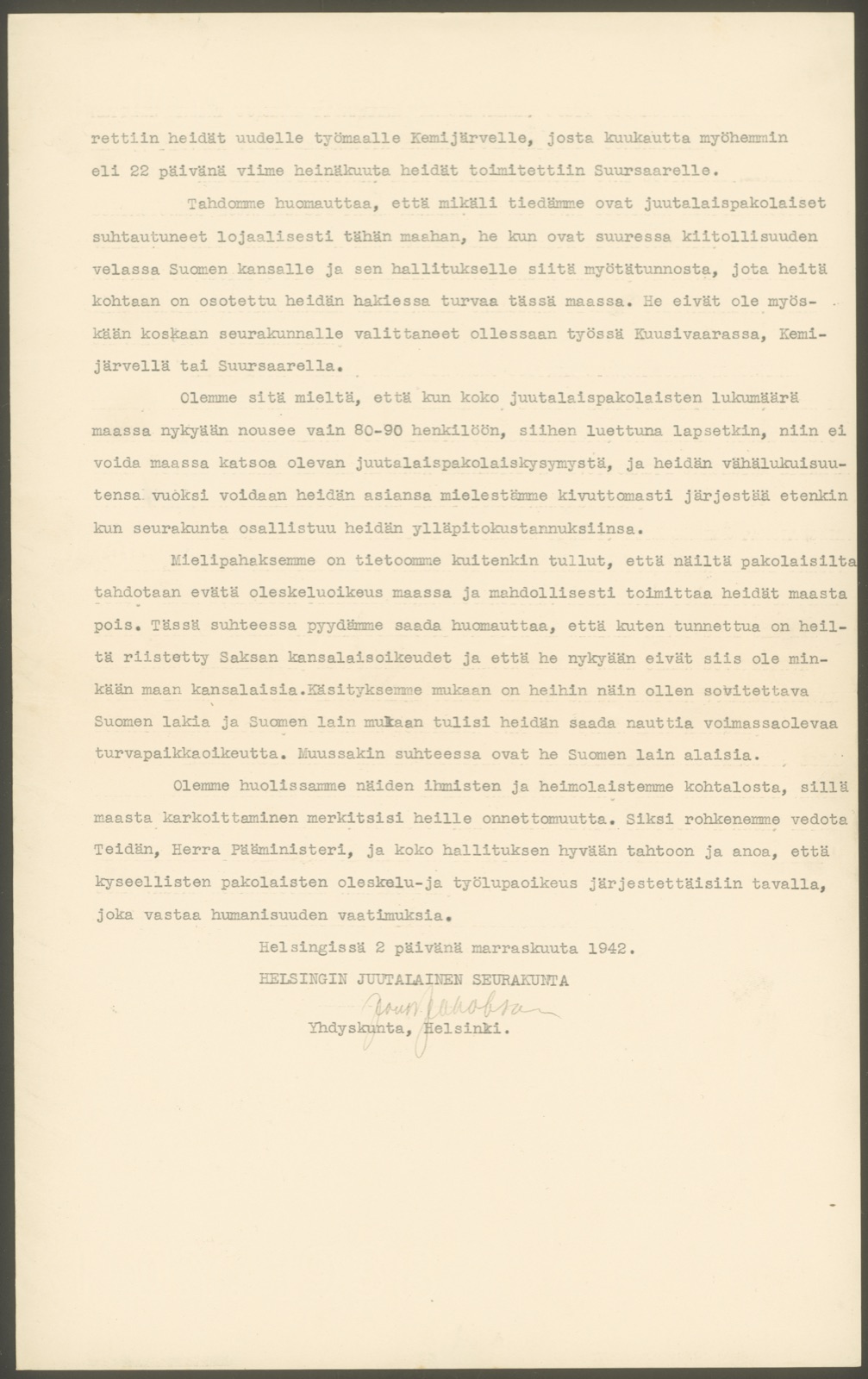
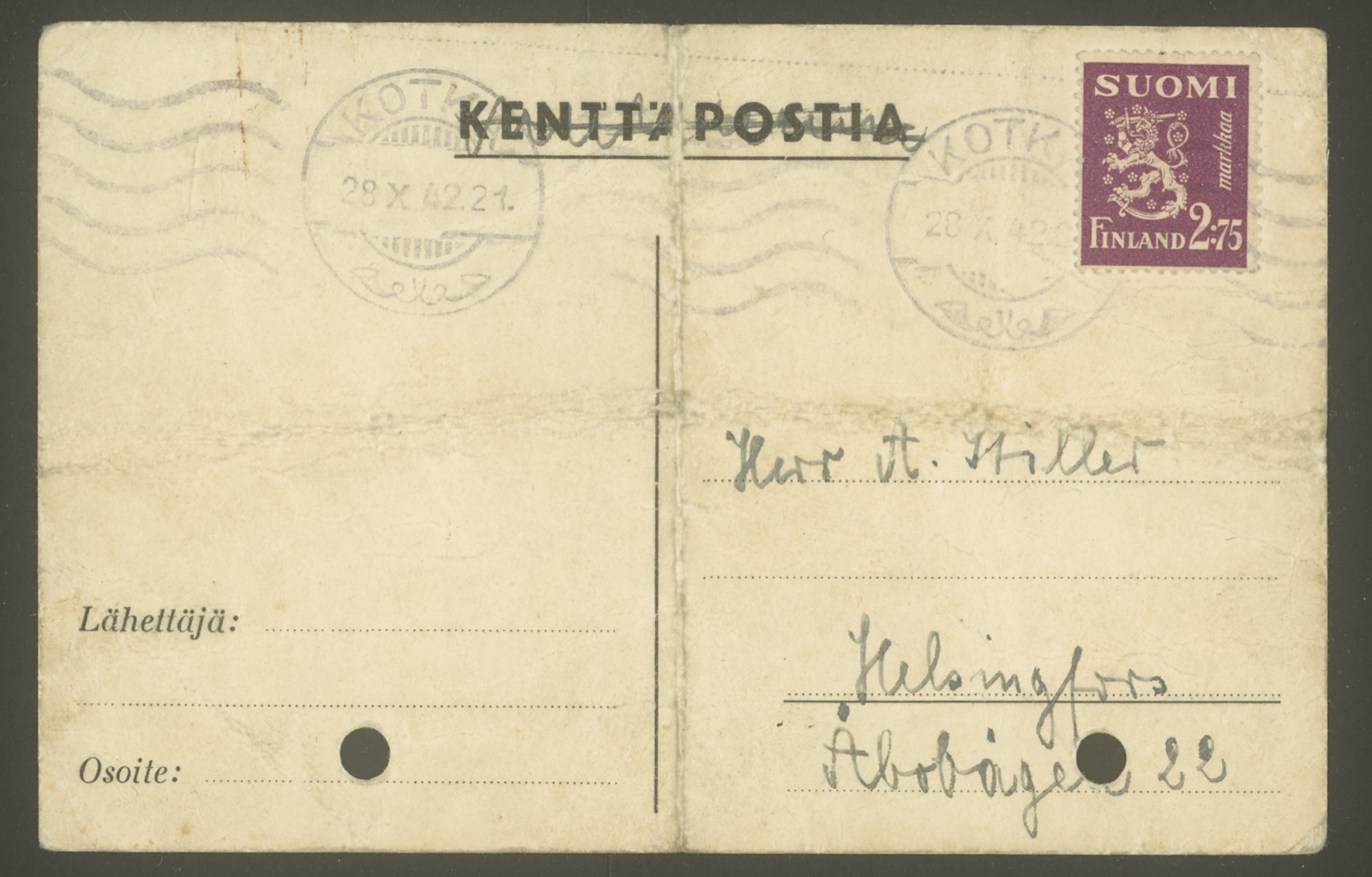
At the end of October 1942, Abraham Stiller, who lived in Helsinki, received a post card from refugees who had been transferred to Suursaari, revealing their impending deportation. Jonas Jakobson, chairman of the Helsinki Jewish community, drafted a memorandum to the Council of State, in which the community appealed for the refugees' residence and work permits to be arranged “in accordance with the requirements of humanity”.
Despite all protests, eight Jewish refugees were deported on 6 November. They ultimately ended up at the Auschwitz-Birkenau concentration camp, and only one of them survived.
Fear of new extraditions
In the spring of 1943, with a new government, the refugees' situation eased somewhat: efforts were made to arrange lighter work duties for the men, for example on farms, and many were released from their work obligation entirely. Refugees were also given greater freedom than before to choose where they lived.
The welfare situation nevertheless remained difficult, and the refugee committee struggled constantly to find funds. At the same time, the leadership of the Jewish community explored the possibilities of moving the refugees to safety in Sweden, as fear of new deportations to Nazi Germany was constantly present.
In the spring of 1944, fear was at its height: both the refugees and Finland's Jews feared that, as Finland sought a separate peace with the Soviet Union, Germany might occupy the country. This had just happened in Hungary, where the occupation was immediately followed by the launch of large-scale persecution of the Jews.
The situation was also assessed as threatening in Sweden, and finally, in May, the refugees were granted visas, with which they were able to move to safety in Sweden.
Brave actions and extensive relief work saved many
The majority of the Jewish refugees who arrived in Finland survived the Holocaust. This was the result of several factors, including the brave actions of individual Finnish authorities, politicians and individuals, the Jewish community's extensive relief work, the support of international organisations, and finally the safety offered by Sweden.
Images