Cities · Viipuri
The Jewish Community of Viipuri
Before the Second World War, Viipuri (present-day Vyborg, Russia) was one of Finland's most vibrant Jewish centres. According to the authorities' records, 257 Jews lived in the city in 1915, and the community was active in religious, economic and cultural life alike.

The Ahdus House as the hub of community life
The Ahdus House became the centre of community life. On 28 January 1919 the community bought a building complex constructed in the 19th century at Linnankatu 23, in the very heart of the city, and the house was ceremonially inaugurated on 9 February 1919.
The Ahdus House quickly became the city Jews' second living room: it housed the community's office, archive, and library. All shared events were held in the great hall — celebrations, dances, concerts by the community's musicians, and plays by Yiddish-language theatre troupes.
Gathering a minyan was easy, as there were always people in the house. In the summer of 1938, the Ahdus House also became a temporary refugee centre when nine refugees who had arrived from Austria were lodged there.
The livelihoods of the community
In 1910, most of the Jews of Viipuri were engaged in trade. Isak Kuschakoff earned his living collecting iron and metal scrap and textile waste. His son took the surname Kuusakoski, and Kuusakoski Oy still operates in the same field, operating an aluminium works in Heinola, among other things.
The Kotimaan Lakkitehdas cap factory, founded by the cap manufacturer Ruben Meyer Steinbock, had by 1910 grown so large that a two-storey factory building was built for it; in 1913 it employed 70 people. The hatter Simha Livson, who had moved from Sortavala, designed the first Civil Guard cap and gained Marshal Mannerheim as a lifelong customer.
Cultural life flourished
Cultural life was exceptionally rich. By the 1930s there were more academically educated Jews in Viipuri than in any other city in Finland. Visiting Finland's Jewish communities in 1928, the Polish doctor Leo Motzkin remarked: “The Jews of Finland can be compared to a human body: the head is in Viipuri, the stomach in Turku and the legs in Helsinki.”
The community produced notable artists, such as the pianist and composer Rakel Levin (née Steinbock), the composer Erna Tauro (née Pergament), the violinist Naum Levin, the Yiddish-language actors Ester Steinbock (née Rosenberg) and Salomon Eckert, the visual artist Samuel Besprosvanni, and the academician Sam Vanni, a pioneer of concretism and abstract art.
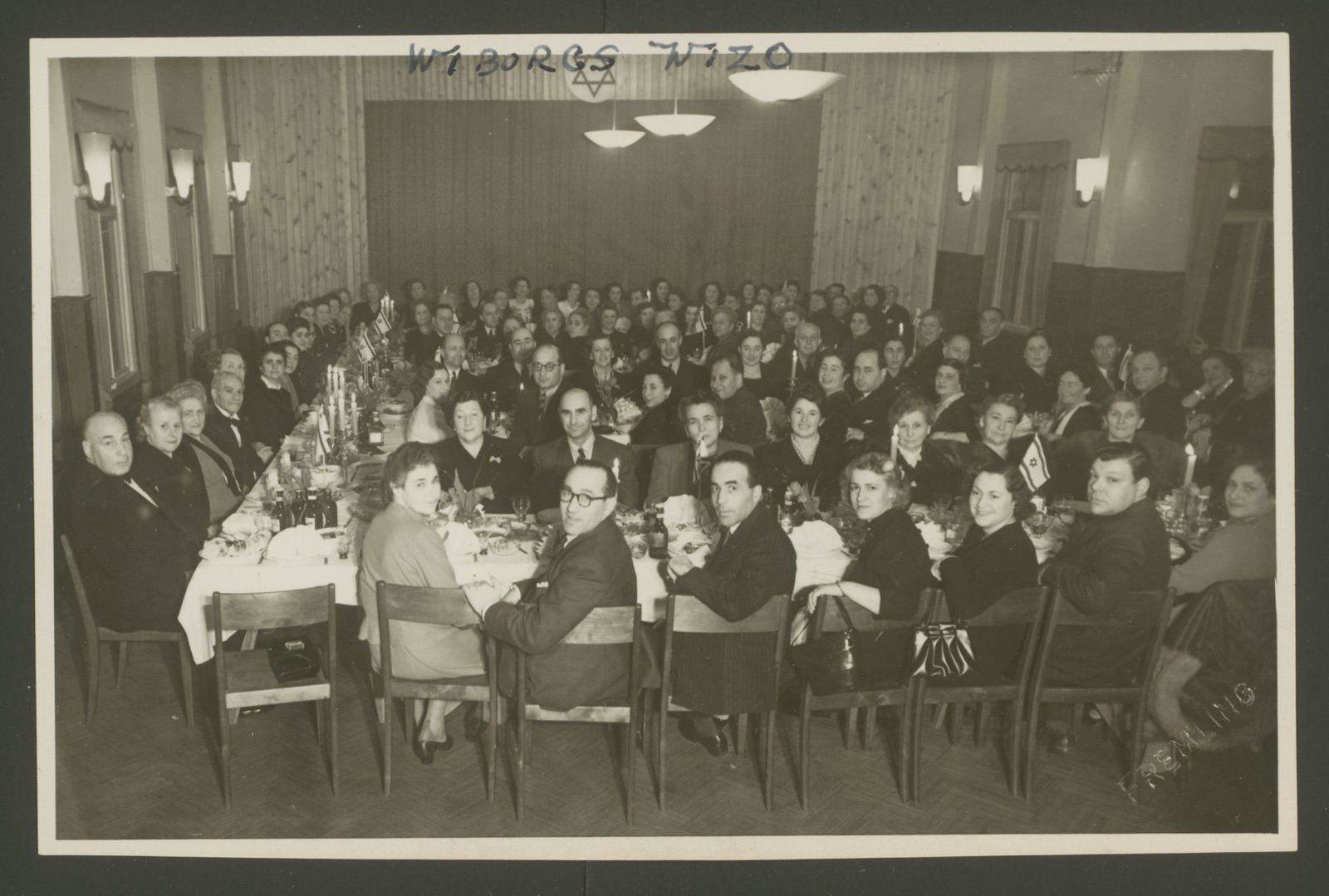
Association and sporting life flourished too. Helmi Jakobson — a convert to Judaism, wife of the lawyer Jonas Jakobson and mother of the minister Max Jakobson — founded Finland's first WIZO association in Viipuri in 1924, and a second women's charitable association was also active in the city.
In 1930 the sports club Kadur was founded, its main sport being football; the boxer Wulf Gurevitsch was Finland's heavyweight champion that same year.
Religious traditions were kept
The people of Viipuri were not especially religious, but nearly everyone had a mezuzah on their doorpost, and weddings and bar mitzvahs were celebrated with traditional rites.
Kosher meat was always available. Rabbi Maslovat, who served as rabbi from 1903 to 1936, had made an arrangement with a butcher named Makkonen who owned two adjacent shops in the market hall. One of them sold kosher meat that was ritually slaughtered by the rabbi.
The legacy of Viipuri
When the Winter War broke out, the Jews of Viipuri were evacuated to Helsinki, Turku and Tampere. The evacuees who settled in Tampere founded their own community there in 1946.
The arrival of the Viipuri Jews hastened the shift to Finnish and the strengthening of women's position in the Helsinki and Turku communities: in Helsinki, women only gained the right to vote in the community in 1944, whereas in Viipuri they had always had it.
Images