Keren Kajemet
Keren Kajemet Finland
Keren Kajemet Finland ry (KKF) is Finland's oldest Israel-related organisation and part of the international Keren Kayemeth LeIsrael organisation, which is the world's oldest environmental organisation still in operation. In Finland, KKF has operated for over a hundred years on a voluntary basis: raising funds, planting forests, supporting Finnish-Israeli cooperation and keeping its activity unbroken even during the years of the Second World War.
Historical roots
Keren Kayemeth LeIsrael was founded in December 1901 at the Fifth Zionist Congress in Basel. The Finnish Keren Kajemet Committee — today Keren Kajemet Finland ry — began its activity immediately after Finland's independence and the Jews' attainment of civil rights in 1918.
The activity was lively from the very beginning. The organisation collected donations, sold tree plantings in Eretz Israel, the Land of Israel, and had the names of distinguished individuals inscribed in the Golden Book.
Operations were already extensive in the 1920s, even though money transfers were challenging: the funds collected were sent to Jerusalem via a London bank and communication was slow. The income of the Helsinki branch was 43,789 marks in 1926 and about 20,000 marks in 1927; the corresponding figures for the Viipuri (present-day Vyborg, Russia) branch were 29,000 and 31,000 marks.
In the latter half of the 1930s, funds accrued mainly through “pushke collections”, KKL's blue collection box, which was a familiar sight in private homes and in associations. In addition, telegram forms, calendars and stamps were sold. In 1933, the Finnish Keren Kajemet, with some twenty donors, collected 11,350 marks for the first forest of the Finnish Jews in Eretz Israel. By 1938, the Helsinki KKL had collected about 120,000 marks, and just before the war there were 97 donors on the collection list, who had donated almost 123,000 marks.
Development over the decades
The war years — operations continue
KKF was the only branch of Keren Kayemeth LeIsrael among the states that fought alongside Germany that remained active throughout the Second World War. The veterans of the Helsinki KKL, Eva Rubinstein-Fortelius, Louis Levinsky and Boris Rubanovitsch, have recalled that the association's operations continued without interruption during the war years of 1939–1944.
Post-war reconstruction
After the wars, Eretz Israel was rebuilt with Finnish donations in a very concrete way as well. The first load of logs and plywood was shipped from Kotka in the autumn of 1946: with the special permission of the Finnish government, the Finnish Jews sent timber as a gift to Jews who had fled the persecutions of Europe, for the building of homes. In December 1946, Johan Parviaisen Tehtaat Oy sent 49,588 cubic metres of Finnish birch plywood from Mäntyluoto, and in the following years several batches of timber were sent by sea from Finland to Israel.
After the establishment of the State of Israel in 1948, a pushke could be found in almost every Jewish home in Finland — both as a decorative object and as a reminder of the Jews' own state. The two December emptyings of the pushke boxes in 1948 yielded together over 173,000 marks.
Finland forests in Israel
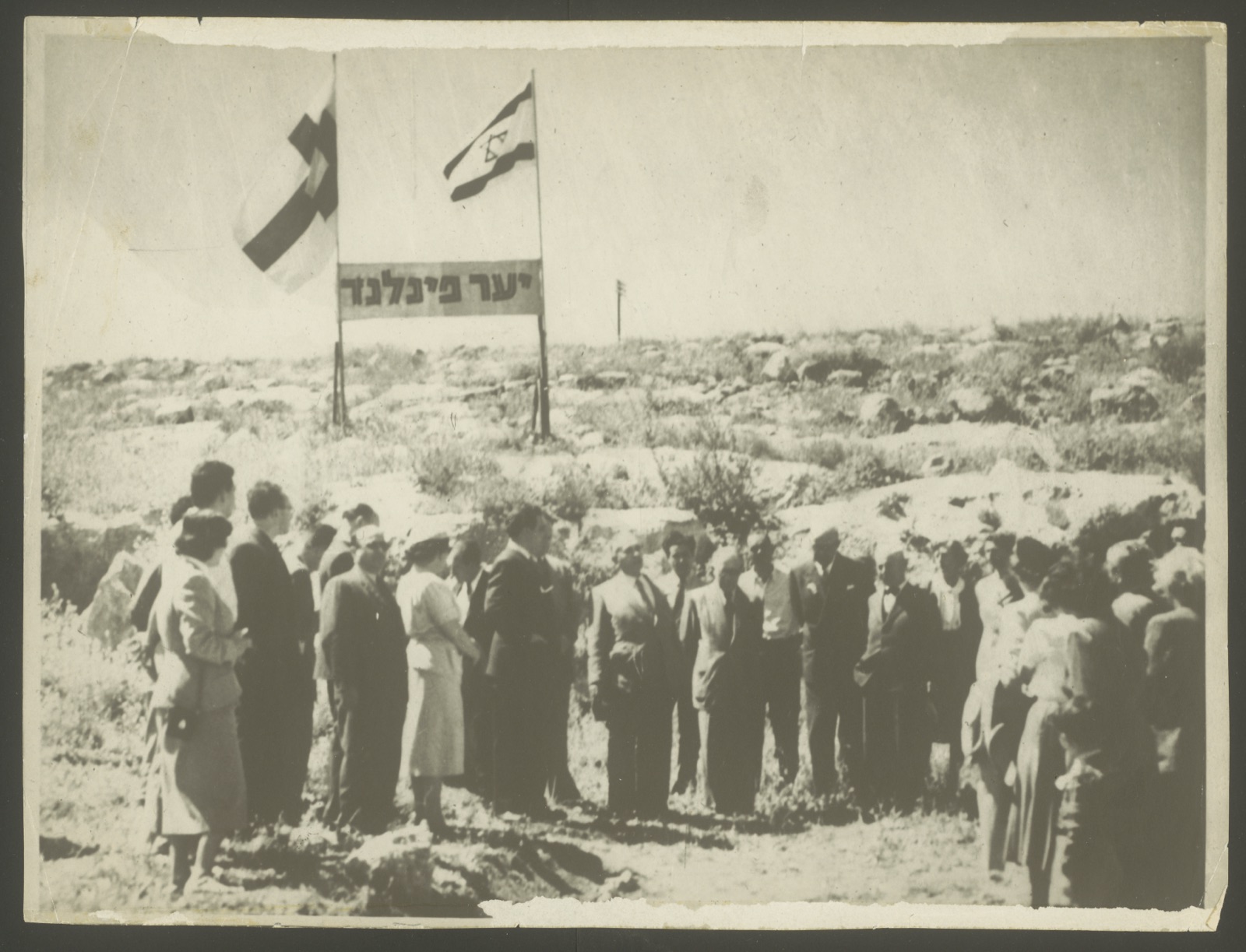
Finland was among the first countries to recognise the establishment of the State of Israel. In 1948, Finland's Jewish organisations decided to plant a forest in Israel in Finland's name, and on 1 April 1951 (24 Adar 5711), the long-planned Finland Forest, Ja'ar Finland, was planted. In 1958, it was decided to plant a second Finland Forest in the area of the Haruvit Forest. By 2026, KKF has planted a total of 15 forests and numerous groves in Israel.
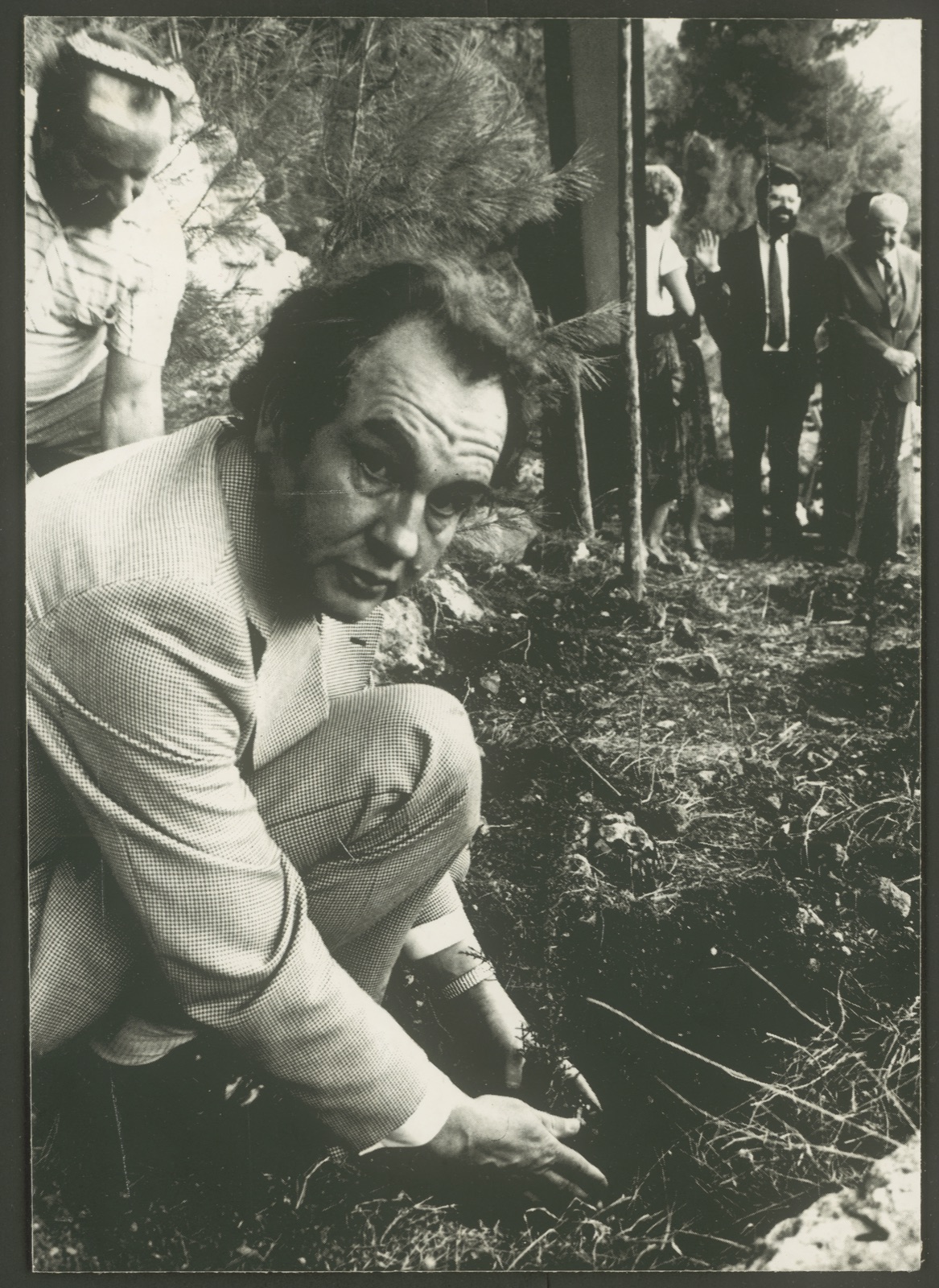
In October 2010, President Tarja Halonen took part in KKL's tree-planting ceremony in the Grove of Nations in the Jerusalem Forest during her state visit.
Expansion of activity in the 2000s
KKF began its activity as a Jewish Zionist organisation among the Finnish Jews, but over time Christian individuals and Christian associations sympathetic to Israel have also joined. Cooperation with the Finnish Karmel Association, for instance, began as early as 1961 and has developed continuously.
Over the years, KKF has carried out many kinds of projects in Israel together with its Nordic sister organisations. The fundraising target of its centenary year 2017–2018 was the Yiftah hiking and recreation area. In cooperation with the KKL organisations of Norway, Sweden and Denmark, projects such as a fire watchtower near Kibbutz Be'er (2012), a forest-management research project in the Ambassadors Forest in the Negev (2013–2014) and the Casuarina Circle, named in memory of Dan Uzan (2016), have been carried out. Dan Uzan was a member of the Danish Jewish community who was killed in 2015 while serving as a guard at the Copenhagen synagogue.
Other projects have included the Tushia playground in cooperation with Denmark (2019), the Finnish classroom at the House of Excellence in Nof Hagalil in Galilee (2020–2021) and Taivas TV7's five groves in the area of Nazareth and Mount Tabor (2014–2023). In 2023, the Ein Goz recreation area was carried out, and in 2024–2025 KKF has taken part in the repair of the security and fire watchtower of Kibbutz Be'er together with Norway and Sweden.
The present day
As of April 2026, KKF has a total of 160 members. The association's board consists of the chair and treasurer Ethel Salutskij, the vice-chair Iakov Dondych, the secretary Anne Willner and the members Yosef Muksin and Jan Cibulka.
Supporters and donors have included members of the community, Christian associations, and other friends of Israel. The association still operates entirely on a voluntary basis. The most central of the ongoing projects is the replanting project of the Amnun Forest in Upper Galilee.
The Amnun Forest is located in Upper Galilee, north of Lake Kinneret. The forest is near the Church of the Beatitudes, Domus Galilaeae, and the archaeological sites of Capernaum and Bethsaida. This is a young forest in which native Israeli species had only recently been planted. The seedlings were planted sparsely, as is typical of the fringe forests of the Mediterranean region, which created an open and scenic landscape.
During the recent war, the forest suffered extensive damage, and in addition, rockets fired from Lebanon prevented the installation of the irrigation system, as a result of which the seedlings died before they had time to take root properly. The Amnun Forest is part of the West Korazim nature reserve, which covers 442.5 hectares.
The forest has grass vegetation and scattered native trees, such as jujube, which makes it a naturally suitable park forest. This has a high ecological value. The war caused much ecological and social damage in northern Israel. Thousands of hectares of forest burned on the hills of Galilee and the Golan, including over 190 hectares of young Amnun Forest. This destruction affects much more than the trees themselves. It disturbs the habitat of wild animals and damages the resilience of the soil.
The destruction limits the safe visiting of the recreation area by residents, hikers and pilgrims. Restoring the forests is essential both to protect the land and to support the communities that depend on it.
Images