Choir
Hazamir
Hazamir is the choir of the Jewish Community of Helsinki and one of the oldest still active Jewish choirs in the world. Its mission is to cherish and revive the Yiddish-language singing tradition and to present Jewish music to a wider audience in Finland and abroad. Maintained by a small community and active for over a century, the choir is a rarity in Jewish Europe where Yiddish has almost disappeared from everyday use.
Historical roots
Judiska Sångföreningen rf – Juutalainen Laulukuoro ry was founded in 1917, the year of Finland's independence, by four community members interested in Jewish music: Samuel Rubinstein, Hillel Schwarzmann, Simon Parmet and Isaac Skurnik. The choir was led by the well-known composer and arranger Simon Parmet (1897–1969) whose best-known works include the soundtrack for Pikku Pietarin piha (1961). At its founding, the choir comprised 60 active singers.
The choir's original performance language was Yiddish. Some melodies, such as Suomis sång (Suomen laulu), were also performed in Swedish. Hebrew was used mainly in religious melodies. Among these was, for example, Ki malachav, which was performed by the male choir at the cemetery. With Israel's independence in 1948, new Hebrew-language melodies also entered the repertoire.
Development over the decades
The chain of directors
The Second World War interrupted the choir's activity, but the choir revived and continued its work after the war. Over the course of its history, the choir has been led by Simon Parmet, Samuel Rubinstein, Isaac Skurnik, Isak Manuel (who also served as deputy director and director of the male choir), Nathan Rubinstein, Harald Andersen, and Leo Skurnik. Piano teacher Eva Jacob led the choir from 1985 to 2012, and the choir is currently led by Mirka Metsäranta, MMus.
In 1967 Leo Skurnik, son of founding member Isaac Skurnik, began to lead the choir. The choir was then reshaped into a youth choir and was given the new name Hazamir, which is the Hebrew word for nightingale.
International performances
Over the decades, the choir has performed both at home and abroad. Judiska Sångföreningen visited Tallinn as early as 1930 and made a Scandinavian tour in 1947. A tour of the United States took place in 1980. The choir has also taken part in the Zimriyah choir festival held in Israel several times. They participated for the first time in 1961 and subsequently in 1970, 1973, 1977 and 1992. Since then, Hazamir has performed at the minority religions exhibition in Paris in 1994, at the festival of Jewish music and culture in Copenhagen in 1996, and at the Tallinn synagogue in 2009. In June 2025, the choir made a concert trip to Vilnius.
Recordings
Hazamir's first EP was released in 1969. One side of the record featured Balalaikka, which was number one on the radio chart for a long time, and the other side Luotan auringon nousuun. In 1983, the choir made a new recording, Folk Songs in Yiddish, in London. The recording was originally on cassette tape and it was later issued as a CD.
Performances in Finland
One of Hazamir's most notable performances in Finland has been the Independence Day memorial event at the Helsinki Synagogue in 1944, which commemorated fallen Jewish soldiers. The guest of honour at the event was President C. G. E. Mannerheim — a gesture that recognised the sacrifice of the Jewish soldiers who had served in Finland at the very time when Europe was living through the darkest years of the persecution of Jews. The choir's 30th-anniversary concert was held at the Sibelius Academy in 1947.
The choir has taken part in numerous music festivals from the 1980s to the 2000s. It performed on MTV3's national broadcast in 1997 and celebrated its 90th anniversary with a concert in Helsinki in 2007. In 2008, Hazamir performed at the concerts for the 60th anniversary of Israel's independence in Espoo and Helsinki, and in 2009 at an event for Jewish war veterans in Helsinki.
In 2010, joint performances with the klezmer band Freilach mit Kneidlach began, and the choir's 100th-anniversary concert was held at the Alexander Theatre in Helsinki in 2017.
Present day
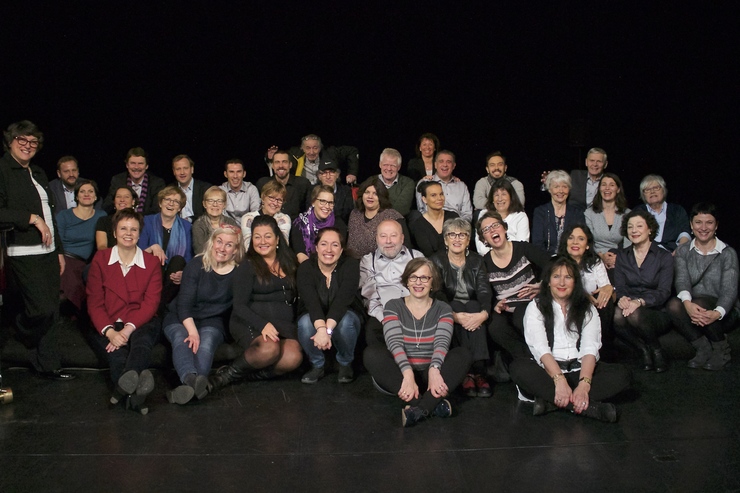
The Hazamir Choir rehearses and performs regularly at the Jewish Community of Helsinki. Presently, the choir consists of about 30 singers, some of whom began as early as the 1960s. Hazamir is a genuinely multigenerational choir: among its singers are families in which the singing tradition has passed from one generation to the next, including the Manuel–Hammermann, Altschuler and Geronik families.
The current repertoire includes, alongside Yiddish-language folk songs, compositions in Hebrew, Finnish and Swedish as well as Israeli music. Arrangements made specifically for Hazamir are especially important, as they carry their own Helsinki Jewish heritage. The arrangements were made mainly by Simon Parmet and Samuel Rubinstein from traditional melodies that Russian Jewish soldiers had brought with them. Among the best-known are Der Rebe Hot Geheissen, Der Alef Beis and Fun Spanien.
Yiddish still lives in Hazamir's melodies
When the Jewish Singing Choir was founded in 1917, Yiddish was the everyday language of Helsinki's Jews. A hundred years later the language has almost disappeared from spoken use but it still lives in Hazamir's melodies. The choir is both the voice and the memory of the community: a bridge from the founders' generation, who built Finnish Jewish cultural life in the newly independent country, to the singers who carry it forward today.
Recordings
Yiddish-language songs sung by the Hazamir Choir.